Issue No. 44 · Climate
The Actuaries Saw It First
Inside the reinsurance industry’s decade-long, mostly silent capitulation to a warmer planet.
By Adam Reilly 12 min read
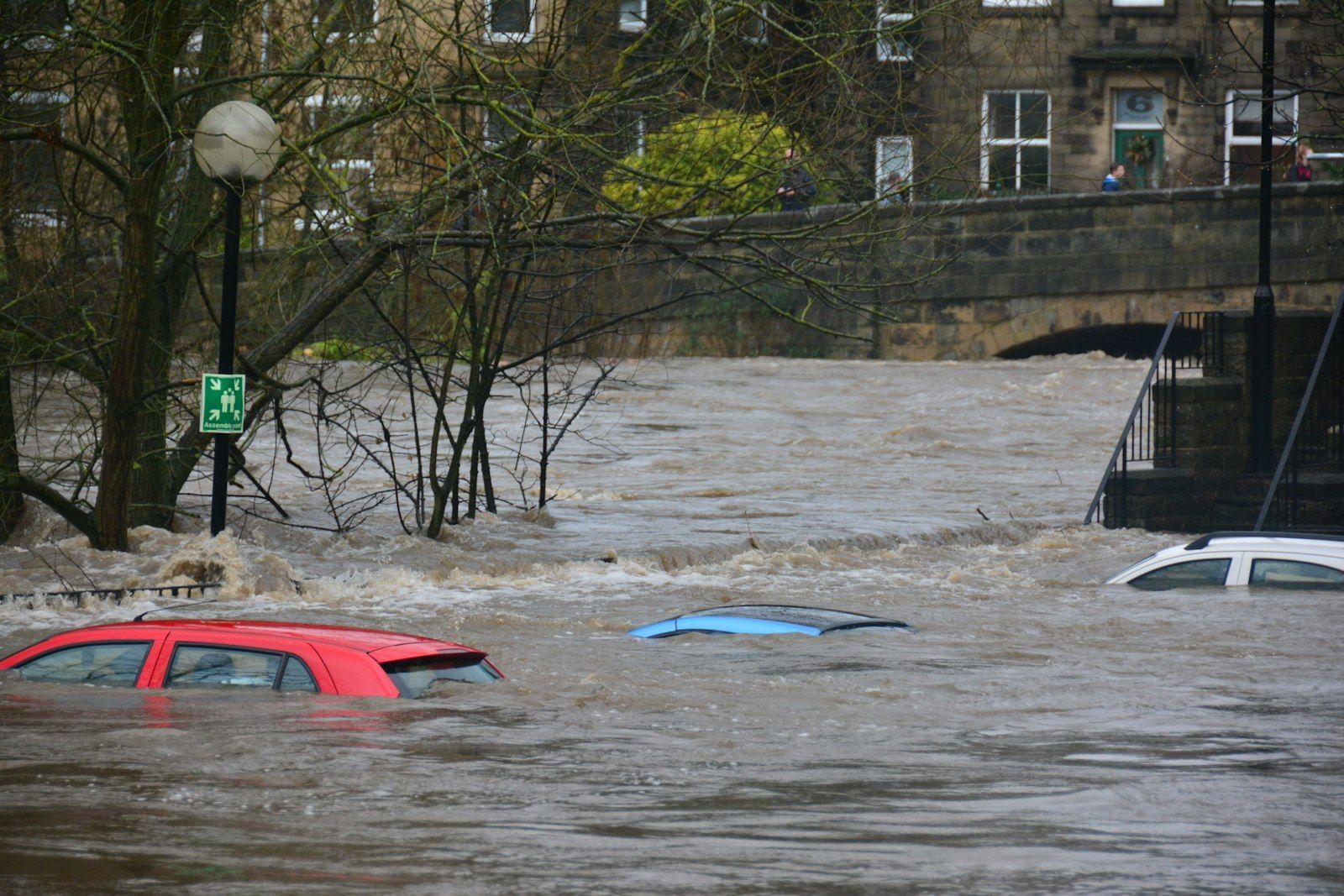
The first industry to capitulate to climate change was not the oil industry, and it was not the airline industry, and it was certainly not, despite its protestations to the contrary, the technology industry. The first industry to capitulate to climate change was the reinsurance industry, and it did so in 2003.
I do not mean that the reinsurers had a road-to-Damascus moment and rewrote their public relations. I mean something narrower and harder to undo. I mean that, starting around 2003 and accelerating sharply after 2017, the largest reinsurance companies in the world — Munich Re, Swiss Re, Hannover Re, the Berkshire Hathaway reinsurance group — began silently revising the catastrophe models they use to price insurance against weather events. The models came up. Then they came up again. Then, in 2023, several of them simply stopped writing coverage in certain American counties altogether.¹
There is no press release for this. There does not need to be one. The market does the talking.
What reinsurance is
A brief primer, because most people do not need to think about this and most of what they hear about it is wrong. Your homeowner’s insurance company — State Farm, USAA, Liberty Mutual — does not, in fact, bear the full risk of paying out on your house. It bears a slice. The rest of the risk it lays off, in turn, to a reinsurance company, which is essentially an insurance company for insurance companies. Reinsurance is what allows a single hurricane to not bankrupt every primary insurer on the Gulf Coast at once.
The reinsurance industry is, in plain terms, the place where the actuarial math actually has to add up. A primary insurer can take a bad year. A reinsurer that takes a bad year takes the bad year for the entire industry. Reinsurers, accordingly, hire the best catastrophe modelers in the world. And those modelers have been quietly, for twenty years now, marking the climate to market.
There is no press release for capitulation in this industry. The market does the talking.
2003, 2017, 2023
Three dates anchor the story. 2003 was the summer of the European heat wave — the one that killed an estimated 72,000 people across the continent. It also broke several reinsurance models for European mortality risk, in the technical sense that the modeled tail of the distribution turned out to be much fatter than the historical data had suggested. Several reinsurers spent the following winter rewriting how heat-related mortality entered their pricing.
2017 was the year Atlantic hurricanes — Harvey, Irma, Maria — caused something north of $300 billion in damages, of which only about a third was insured. The uninsured two-thirds is the relevant number. It is the size of the protection gap, which is what the industry calls the difference between what was lost and what was covered. The protection gap, after 2017, was understood to be the central problem of the next decade.²
2023 was the year State Farm stopped writing new homeowners policies in California, citing wildfire risk, and Allstate followed. AIG had already stopped writing in parts of Florida. Citizens Property Insurance Corporation, Florida’s state-run insurer of last resort, was by then carrying 1.3 million policies, a number it had been built explicitly to never have to carry.
What the actuaries actually do
I have spent more time than is strictly healthy reading reinsurance trade publications, because they are the place where the climate conversation is happening with the gloves off. There is none of the political tip-toeing of an IPCC report and none of the rhetorical excess of an op-ed. There is just a series of polite, devastating sentences about how the loss-cost curve for a category of risk is no longer stationary, and what that does to a balance sheet.
A specific kind of sentence shows up over and over in these reports. It goes roughly: "Recent loss experience has diverged from historical baselines in a manner consistent with non-stationarity in the underlying hazard." Translated: the math has stopped working, because the world the math was about is gone.
When a reinsurer writes that sentence, what they do next is reprice. Repricing, in this context, is not a five percent annual increase. Repricing is a 240 percent annual increase in coastal Louisiana, or a withdrawal from the market in three counties in Arizona, or a quiet decision that a particular kind of wildfire-prone property is no longer insurable at any price. These are not theoretical decisions. They are the decisions that decide, in the next decade, which neighborhoods continue to be mortgageable and which do not.³
The state of last resort
When the private market exits a region, the state, usually, steps in. Florida has Citizens. California has the FAIR Plan. Texas has the TWIA. Louisiana has Citizens Coastal. These are insurers of last resort, and they exist precisely so that a market exit does not become a credit-market exit — because if a house is uninsurable, it is also unmortgageable, and a town in which no house is mortgageable is a town that very quickly stops being a town.
The state insurers of last resort are, mostly, doing their jobs. They are also, mostly, undercapitalized and underpriced for the actual loss curve, because they are political entities and not market actors. The reinsurance industry knows this. The state insurers know it too. The conversation, increasingly, is about who pays when the state insurer of last resort is itself overwhelmed, which several of the modelers I trust think will happen, somewhere, in the next ten years.
The actuaries saw this first. They have been seeing it, with increasing alarm, since the early 2000s. They are not climate activists; some of them, in their personal politics, are quite conservative. They are simply people whose job is to make the math add up, and the math has, for a long time now, refused to.
If you want a clear-eyed view of where the climate is actually going, you can read the IPCC reports, which are good and which have to be politically negotiated word by word. Or you can read the annual "Sigma" report from Swiss Re. The Sigma report does not have to be negotiated with anyone. The Sigma report just has to be true.
Notes
- 1. See Swiss Re Institute, "Sigma 03/2025: Natural catastrophes in 2024," and Munich Re’s NatCatSERVICE summary for the same year.
- 2. The standard reference for protection-gap analysis after 2017 is Lloyd’s of London, "Closing the Insurance Gap," published in 2018.
- 3. See Benjamin Keys & Philip Mulder, "Neglected No More: Housing Markets, Mortgage Lending, and Sea Level Rise," NBER Working Paper 27930, with updates through 2024.
If this is your sort of thing, get the next one.
One long essay, every Sunday. No advertising, no tracking pixels, no five-things-to-do-in-five-minutes. Just twenty-two thousand readers and a single, well-cared-for email.
Free. Unsubscribe in one click. We never share the list — we have nobody to share it with.